People often call Chinese New Year a single day. It is really a period of two weeks with a before and an after. First comes a week of preparation. Then comes one loud night. Then come fifteen days of visits that end with lanterns.
The order of these Chinese New Year traditions matters, because each stage has its own rules. Traditions differ by region, and the order stays the same. The traditions below are the ones a visitor is most likely to meet. City families keep fewer traditions than village families, but they keep the same ones. These traditions survive because they are simple. Cooking and cleaning belong to the days before the festival. Families stop sweeping and washing on the first day. They welcome the wealth god on the fifth day. The season closes on the fifteenth day. This page gives that sequence with the 2027 dates.
Before: the week of preparation
Preparation begins on 小年 (xiǎonián, Little New Year). That is the 23rd or 24th day of the twelfth lunar month, depending on the region. On this day the family sends the kitchen god up to report on the household. After that the work is practical. The family cleans the house from top to bottom. It pays its debts, cuts hair, buys new clothes, and dresses the door.
- Deep clean. 扫尘 (sǎo chén) sweeps away the dust of the old year, and by a pun, its bad luck. Families do this before New Year's Day and never on it.
- Spring couplets. 春联 (chūnlián) are red paper strips with parallel lines. Families paste them on either side of the door, with 福 (fortune) on the panel. The character often hangs upside down, because 倒 (dào, upside down) sounds like 到 (dào, to arrive).
- New clothes. A new item on the first day signals a fresh start. Red is preferred, and black and white are avoided.
- Food. Families make dumplings in the north and rice cakes in the south, in batches. The kitchen fills with food that keeps.
- Haircut. Families cut hair before the festival. Some families still avoid a haircut during the first lunar month.
New Year's Eve: the reunion dinner
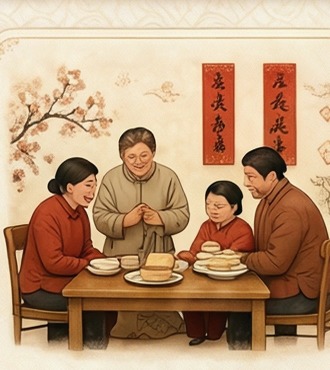
除夕 (chúxī) is the heart of the festival. It is a family meal, not a public event. Families travel very long distances for it, and the travel rush called chunyun is built around this one evening. The meal is served at home, or in a restaurant that the family books months ahead. The dishes carry wishes. Fish means surplus (年年有余). Dumplings are shaped like ingots. Rice cake means rising (年糕, niángāo, sounds like 'higher year').
After dinner, families stay up past midnight. This is 守岁 (shǒusuì), 'guarding the year', and the television stays on. The CCTV Spring Festival Gala is part of that night. It started in 1983, and families still watch it. Complaining about the gala is now part of the tradition too. Firecrackers were once the soundtrack. Most Chinese cities banned them for air quality, so the noise moved to the countryside and to official displays.
The fifteen days
| Day | Name | Custom |
|---|---|---|
| 1 | 春节 chūnjié | Visits to elders, temple incense, lion dances, no sweeping |
| 2 | 回娘家 huí niángjiā | Married daughters visit their parents, with gifts for the table |
| 3 | 赤口 chìkǒu | 'Red mouth', a day to stay home and avoid arguments in Cantonese tradition |
| 4 | 接神 jiēshén | The household gods return. Families set out offerings again. |
| 5 | 破五 pòwǔ | Taboos lift. Families welcome the wealth god. Shops reopen with firecrackers. |
| 7 | 人日 rénrì | 'Everyone's birthday'. The south eats seven-vegetable soup. |
| 9 | 天公诞 tiāngōngdàn | The Jade Emperor's birthday, most visible in Hokkien communities |
| 15 | 元宵节 yuánxiāojié | Lantern Festival: lanterns, riddles, tangyuan rice balls |
The taboos, and where they come from
Most of the traditions below come from homophones, and most New Year taboos are homophones in disguise. A homophone is a word that sounds the same as another word. Families sweep nothing on the first day, because sweeping removes the luck. They break nothing if they can help it. If something breaks, the words 岁岁平安 (suìsuì píng'ān, peace year after year) repair it, because 碎 (suì, broken) sounds like 岁 (suì, year). Knives and scissors stay in the drawer, because sharp things cut good fortune.
- No sweeping or taking out the trash on day one.
- No washing hair on day one in many families, because 发 (fà, hair) sounds like 发 (fā, to prosper).
- No lending money and no debt collection. Both set the tone for the year.
- No crying children and no angry words. Families avoid funerals and hospital visits if they can.
- No white or black clothing. No clocks, pears or umbrellas as gifts. The reasons are in Chinese New Year gifts.
Where the Chinese New Year traditions come from
The festival is so old that its origin is a layering of customs, not a single date. Its agricultural core came first. That core is the turn of the year, the end of winter and the first plowing. It predates any written record. By the Han dynasty (202 BC – AD 220) the first month was fixed as the start of the year. The customs of visiting, feasting and driving off evil were established by then. The Tang and Song dynasties added the lantern displays, the couplets and much of the food tradition that survives today.
Most people hear one story about the origin. A monster called 年 (nián) fears red, noise and light. That story is a later folk explanation of customs that already existed. It is not the origin of those customs. It is a good story for children because it explains the three things they can see: the red, the firecrackers and the lanterns. In 2024 UNESCO inscribed the Spring Festival on its Representative List of the Intangible Cultural Heritage of Humanity. UNESCO described the festival as a set of social practices around family reunion and the turn of the year.
How Chinese New Year traditions work in China today
Inside China the festival is both private and enormous. The private part is the dinner and the visits. The enormous part is chunyun, the 40-day travel season around the festival. During chunyun, hundreds of millions of people move between cities and hometowns by train, coach and car. It is the largest yearly movement of people anywhere.
Public celebration concentrates in three places. The first is temple fairs (庙会, miàohuì) in parks and temple grounds, with food stalls and folk performance. The second is shopping districts, which stay lit and open through the holiday. The third is television, where the gala runs on New Year's Eve and variety shows fill the two weeks. Most large cities ban fireworks. Some smaller cities permit them, and a few cities organize official displays.
Explained for kids
- Chinese New Year happens on a different date each year, because it follows the moon and not the sun.
- Families clean the house to sweep out bad luck. Then they put red paper on the door to keep bad luck out.
- Everyone eats a big dinner together on New Year's Eve. It is the most important meal of the year.
- Children receive red envelopes with money inside. Adults tell them not to open the envelopes straight away.
- The festival lasts fifteen days, with lion dances, lanterns and sweets. It ends with a lantern festival.
What is celebrated on the first day of Chinese New Year?
New Year visits. Families call on their elders to exchange greetings, and children receive red envelopes. Temples hold the first incense of the year, and lion dance troupes perform in the streets. The loud fireworks belong to New Year's Eve.
How long do Chinese New Year traditions last?
Fifteen days, from New Year's Eve to the Lantern Festival. Preparation starts a week earlier. The public holidays are shorter than the festival itself.
Why do families not sweep on Chinese New Year?
Because sweeping removes the luck of the year from the house. The rule applies to the first day. Families clear the trash before the festival instead.
Is Chinese New Year the same as Lunar New Year?
Chinese New Year is the Chinese festival. Lunar New Year is the wider term, and it covers Korean Seollal and Vietnamese Tết. Those festivals fall on or near the same day, but they have their own customs.