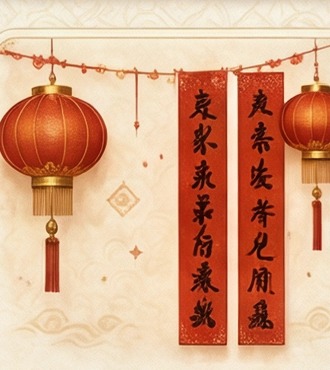
Chinese New Year symbols are not only ornament, and the colors carry the same kind of meaning. Red keeps something out. Gold invites something in. The words on the paper are usually puns, because the same sound carries a wish. The symbols below appear on paper, cloth and metal, and each one carries a wish.
The colors of Chinese New Year
| Color | Chinese | Meaning | Where it appears |
|---|---|---|---|
| Red | 红 hóng | Luck, joy, protection from evil | Envelopes, couplets, lanterns, clothing |
| Gold | 金 jīn | Wealth, imperial authority | Foil on envelopes, lantern trim, temple roofs |
| White | 白 bái | Mourning, avoided entirely | Funerals only |
| Black | 黑 hēi | Formal, solemn, avoided at New Year | Calligraphy ink, modern design |
| Yellow | 黄 huáng | Imperial, auspicious | Temple banners, gold-adjacent trim |
The characters
- 福 fú means fortune. It is the most common character in the festival, and it appears on paper squares, envelopes, plates and phone cases. Families hang it upside down, because 倒 (upside down) sounds like 到 (arrive). Fortune arrives.
- 春 chūn means spring. It goes on the door panel above the couplets, and on the paper cut-outs in windows.
- 囍 shuāngxǐ means double happiness. It is a wedding character, but it appears on New Year packaging as a general wish for joy.
- 年年有余 niánnián yǒuyú means surplus every year. This is the wish behind the fish on the table and the fish motifs on everything else.
- 恭喜发财 gōngxǐ fācái is a wish for prosperity. It is the greeting most often printed on envelopes.
The symbols on doors and tables
- Lanterns (灯笼) hang in pairs at the door. They are red, with gold tassels. The round shape means unity, and the light drives off the dark. They return in force on the fifteenth day.
- Spring couplets (春联) are two vertical strips of red paper with parallel lines, one on each side of the door, plus a horizontal strip above. The couplet is a literary form. The two lines must match in rhythm and meaning.
- Paper cuttings (窗花) are red silhouettes of fish, flowers and characters, pasted on windows. The craft is an art form in its own right.
- Auspicious clouds (祥云) are the scalloped cloud motif on textiles, porcelain and temple beams. They mean that good fortune is arriving. This is the safest decorative element to borrow, because it carries no religious claim.
- Fish (鱼) appear on the table as a whole steamed fish, and on paper as a motif. The pun on 余 (surplus) is the point.
- Firecrackers (鞭炮) were originally bamboo that people threw into fire to make noise. Now they are red paper strings, and most large Chinese cities ban them.
- Nianhua (年画) are woodblock prints sold for the New Year. They were the main visual art of the festival in the past. Common pictures are a plump baby, a door god, and a scene of plenty.
Plum blossom, and the flowers of the season
Plum blossom (梅花, méihuā) is the flower of the festival because it blooms in the cold, before the leaves. It is a picture of endurance and of spring arriving early. People read its five petals as the five blessings: longevity, wealth, health, virtue and a good death. Families cut branches and force them indoors so that they open on New Year's Day.
The other flowers carry their own wishes. Peony means prosperity, orchid means refinement, chrysanthemum means longevity, and peach blossom means romance. In a Western home, a branch of quince or forced cherry works as a stand-in. It is closer to what a Chinese florist sells in February.
Using the symbols without overdoing it
One rule separates a designed room from a decorated one. Pick one motif and give it space. A single pair of lanterns, a red 福 on a plain door, or one branch of blossom does more than a wall of red and gold.
- Choose two colors, such as red and cream or gold and ink. Keep everything else neutral.
- Use one character, not five. 福 is the safest, and it is the most recognizable.
- Let the red be a true vermilion or a deep oxblood, not a bright scarlet. It photographs better, and it reads as Chinese rather than as Christmas.
- If you use clouds, use them as a border or as one large shape. Do not use them as wallpaper.
- Put the greeting somewhere that people will read it, such as a card or a small framed print. Do not repeat it on every surface.
What do the colors of Chinese New Year mean?
Red stands for luck and protection from evil. Gold stands for wealth and imperial authority. White and black are mourning colors, and families avoid them during the festival.
Why is 福 hung upside down?
Because 倒 (dào, upside down) sounds like 到 (dào, to arrive). Fortune arrives. The pun only works when the character is inverted.
What does plum blossom symbolize at Chinese New Year?
It means endurance and early spring, because the tree flowers in the cold. People read its five petals as five blessings: longevity, wealth, health, virtue and a peaceful end.
Is it OK for a non-Chinese person to use these symbols?
Yes, and it is common in international design. Keep it to one or two motifs, use them as intended rather than as generic ornament, and avoid funeral choices such as white wrapping.